
Key takeaways
- ICMR-NIN 2024: about 8 glasses (2 litres) of water, including beverages, per day for a healthy adult, more in heat and with exercise.
- EFSA (2.0–2.5 L) and US (2.7–3.7 L) figures include water from food, so they look higher.
- Heat, humidity, activity, body size and pregnancy all raise your needs.
- Pale urine and stable morning weight show you're drinking enough; thirst is a good guide at rest.
- Overdrinking during long events can cause hyponatremia. Drink to thirst.
"How much water to drink in a day" is one of the most common health searches in India. The internet answers with 8 glasses, 3 litres, or half your body weight in ounces. Here's what the official guidelines actually say, why your number may be higher or lower, and how to tell if you're getting it right.
What the guidelines say
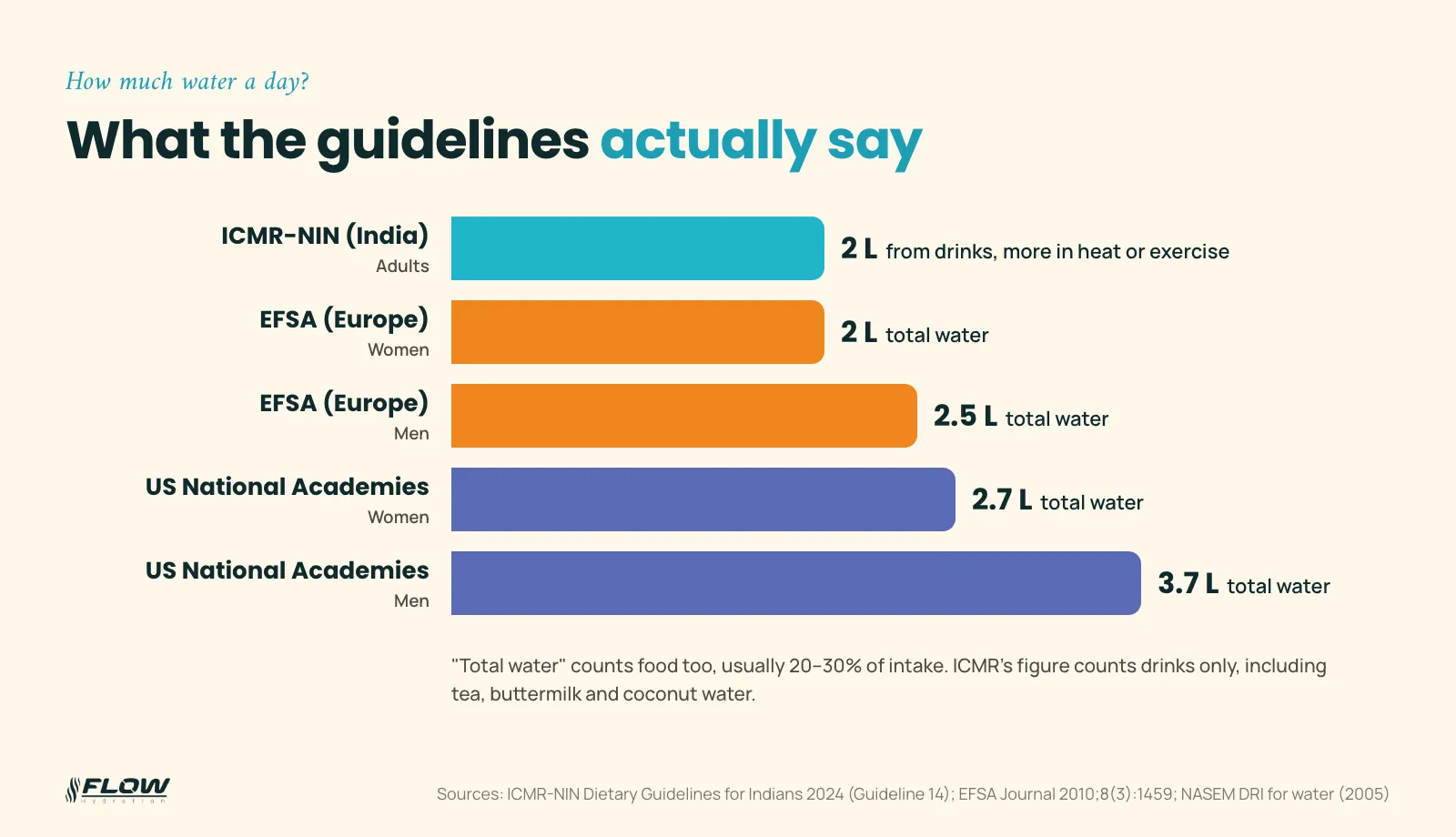
- ICMR-NIN (India, 2024): "A normal healthy person needs to drink about eight glasses (approximately two litres) of water including beverages per day." The requirement rises in very hot weather and with vigorous activity.1
- EFSA (Europe): 2.0 litres of total water a day for women and 2.5 litres for men.2
- US National Academies: 2.7 litres a day of total water for women and 3.7 litres for men.3
The numbers look different but are closer than they seem. "Total water" includes the water in food, usually about 20–30% of intake. Indian meals heavy in dal, rice, curd and vegetables supply a fair amount. ICMR's 2 litres counts drinks only, and explicitly includes beverages such as buttermilk, lemon water and tender coconut water.1
Is "8 glasses a day" a myth?
Partly. A widely cited review found no scientific study behind a rigid "at least 8 × 8 oz" rule for healthy, sedentary adults in temperate climates, and noted that tea and coffee count towards intake.4 But the same review stresses that larger intakes are needed with heat and vigorous work, which describes a lot of Indian days. ICMR's 8 glasses (about 2 L) is a sensible baseline, not a ceiling or a target to force.
Why your number is different
The largest study of daily water turnover, using isotope tracking in 5,604 people across 23 countries, found it varied with body size, physical activity, athletic status, pregnancy, air temperature, humidity and altitude.5 It also found higher turnover in lower-income countries, where more people do physical work in hot climates.
In practice, you need more if you:
- Exercise, especially outdoors. Sweat losses commonly run 0.5–1.5 litres an hour.
- Work outside, commute on a two-wheeler or live in a hot, humid city
- Are pregnant (ICMR suggests more than 2 litres a day) or breastfeeding1
- Have a fever, diarrhoea or vomiting
Exercise physiologist Dr Andy Galpin, on the Huberman Lab podcast, offers a rule of thumb for drinking during exercise: body weight in pounds ÷ 30 = ounces every 15–20 minutes.9 In metric that's about 2 ml per kg every 15–20 minutes, roughly 450–600 ml an hour for a 70 kg person, which sits inside ACSM's guidance. Treat it as a starting point, then adjust to your own sweat rate.
How to tell if you're drinking enough
- Urine is pale straw coloured, and you pee every few hours during the day.
- Thirst isn't nagging you. In healthy adults, thirst is a reliable guide except in heat, during exercise and in older age.6
- Body weight is stable from morning to morning.
Our dehydration guide has a full urine colour chart.
Can you drink too much water?
Yes. Drinking far beyond your losses dilutes blood sodium, called hyponatremia. It's rare in daily life but a real risk in marathons, long treks and drinking challenges. The international consensus on exercise-associated hyponatremia names overdrinking as the main cause and recommends drinking to thirst.7 Symptoms include nausea, headache, confusion and swelling of the hands. If you're weighing more after a long event than before it, you drank too much.
What counts as water?
Water, tea, coffee, milk, buttermilk, nimbu pani and coconut water all count. Fruit and dal count too. In a trial comparing 13 drinks, tea, coffee, beer and sports drinks hydrated about as well as water over four hours. Milk and an oral rehydration solution were retained even better.8 What ICMR says to cut back on is sugary soft drinks and packaged juices.1
If you're sweating heavily, add sodium. Water alone doesn't replace it. See electrolyte powder: who needs it.
Frequently asked questions
How much water should I drink a day in India?
Is 3 litres of water a day too much?
Do tea and coffee count towards water intake?
How do I know if I'm drinking enough water?
References
- 1.ICMR–National Institute of Nutrition. Dietary Guidelines for Indians, 2024 (Guideline 11: Restrict salt intake; Guideline 14: Drink adequate quantity of water). www.nin.res.in/dietaryguidelines/
- 2.EFSA Panel on Dietetic Products, Nutrition, and Allergies. Scientific Opinion on Dietary Reference Values for water. EFSA Journal. 2010;8(3):1459. doi.org/10.2903/j.efsa.2010.1459
- 3.Institute of Medicine (National Academies). Dietary Reference Intakes for Water, Potassium, Sodium, Chloride, and Sulfate. Washington, DC: National Academies Press; 2005. doi.org/10.17226/10925
- 4.Valtin H. "Drink at least eight glasses of water a day." Really? Is there scientific evidence for "8 × 8"? Am J Physiol Regul Integr Comp Physiol. 2002;283(5):R993–R1004. doi.org/10.1152/ajpregu.00365.2002
- 5.Yamada Y, Zhang X, Henderson MET, et al. Variation in human water turnover associated with environmental and lifestyle factors. Science. 2022;378(6622):909–915. doi.org/10.1126/science.abm8668
- 6.Popkin BM, D'Anci KE, Rosenberg IH. Water, hydration, and health. Nutr Rev. 2010;68(8):439–458. doi.org/10.1111/j.1753-4887.2010.00304.x
- 7.Hew-Butler T, Rosner MH, Fowkes-Godek S, et al. Statement of the Third International Exercise-Associated Hyponatremia Consensus Development Conference, Carlsbad, California, 2015. Clin J Sport Med. 2015;25(4):303–320. doi.org/10.1097/JSM.0000000000000221
- 8.Maughan RJ, Watson P, Cordery PA, et al. A randomized trial to assess the potential of different beverages to affect hydration status: development of a beverage hydration index. Am J Clin Nutr. 2016;103(3):717–723. doi.org/10.3945/ajcn.115.114769
- 9.Huberman Lab podcast. Dr. Andy Galpin: Optimal Nutrition & Supplementation for Fitness (Guest Series, episode 6). 22 February 2023. www.hubermanlab.com/episode/dr-andy-galpin-optimal-nutrition-and-supplementation-for-fitness
Kavya · Flow Hydration team
Writes about everyday hydration: water, coconut water, nimbu pani and what Indian dietary guidelines actually recommend.
First published 7 May 2026. This article is general information, not medical advice. If you have a medical condition, talk to your doctor.
Keep reading
12 October 2026 · 9 min read
Electrolyte Powder: Benefits, Uses and Who Actually Needs It
What each electrolyte does, the benefits the research supports, who needs a sachet and who doesn't, and how to read a label in India.
Read more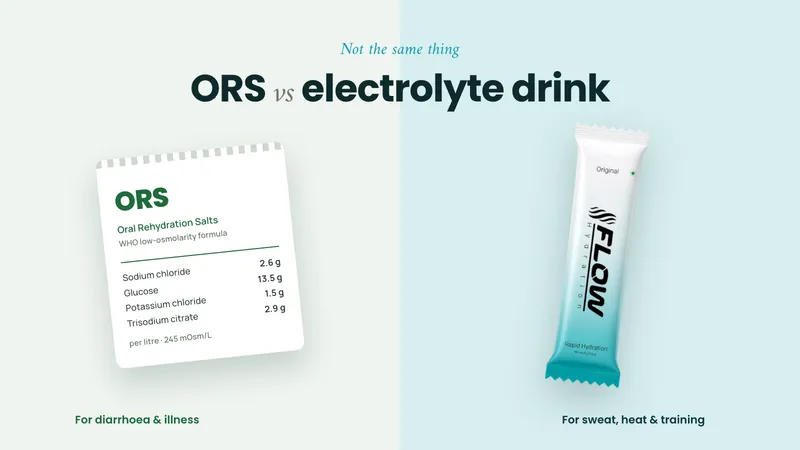
12 October 2026 · 8 min read
ORS vs Electrolyte Drinks: What's the Difference (and What FSSAI Changed)
ORS isn't banned, but sugary drinks can no longer use its name. The WHO formula, what FSSAI changed, and when to choose ORS over an electrolyte drink.
Read more
12 October 2026 · 8 min read
Dehydration Symptoms in Adults: Signs, Urine Colour Chart and What to Drink
How dehydration feels at 1–2% and when it becomes an emergency, plus a urine colour chart and what to drink at each stage.
Read more